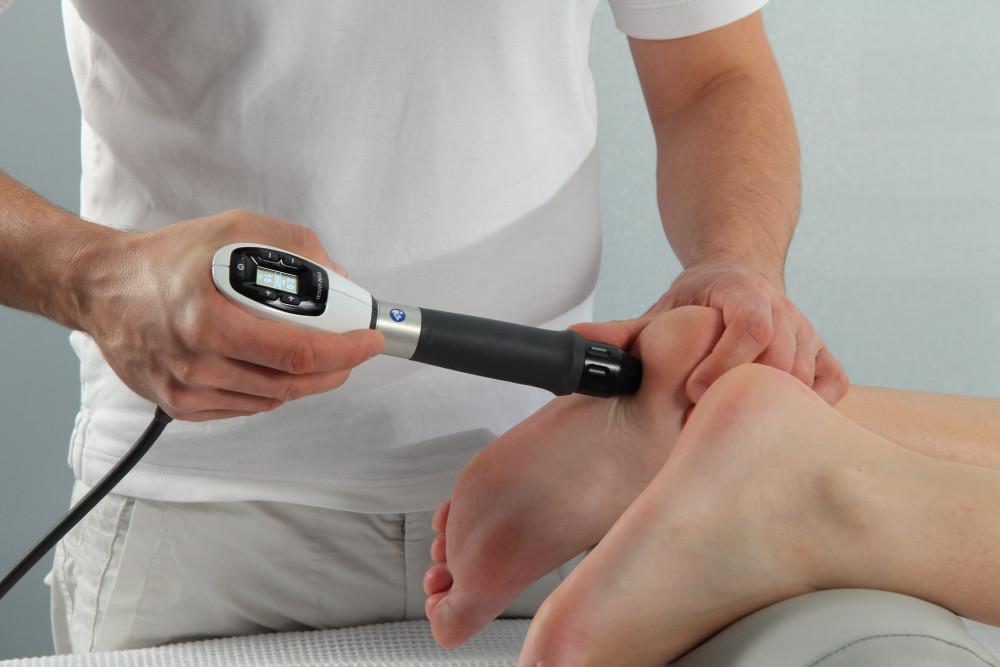
Extracorporeal Shockwave Therapy for stubborn tendon and soft tissue conditions — a proven, non-surgical path back to pain-free movement when other treatments have fallen short.
Schedule a Session
Extracorporeal Shockwave Therapy (ESWT) uses high-energy acoustic pressure waves delivered through the skin to target damaged tissue. The mechanical stimulus triggers a biological cascade — increasing blood flow, breaking down calcific deposits, stimulating collagen production, and reducing local pain signals.
It is one of the most well-researched non-surgical interventions in sports medicine, with a strong evidence base across a wide range of tendon, ligament, and musculoskeletal conditions. For many patients, shockwave succeeds where months of conventional treatment have not.
Dr. Nelson selects the right modality — or combines both — based on the specific condition, tissue depth, and treatment goals.
Delivers pressure waves that radiate outward from the point of contact, covering a broader surface area. Ideal for conditions affecting larger muscle groups or superficial soft tissue.
Best for: myofascial trigger points, broader tendinopathies, shin splints, IT band issues.
Concentrates energy at a precise focal point deep within tissue — reaching structures up to 12 cm below the surface. Highly targeted for specific lesions.
Best for: deep tendon pathology, calcific tendonitis, chronic insertional Achilles, patellar tendinopathy.
One of shockwave's most proven applications — lasting relief for chronic heel pain that has not responded to orthotics, stretching, or injections.
Both mid-portion and insertional Achilles conditions respond well, particularly focused ESWT for deep insertional pathology.
Including calcific tendonitis and chronic tendinopathy — shockwave breaks down calcium deposits and promotes tendon remodeling.
Lateral and medial epicondylitis that lingers despite rest and conservative care — shockwave addresses the degenerative tissue directly.
Jumper's knee — a common and often chronic issue for athletes. Focused shockwave reaches the deep patellar tendon fibers effectively.
Greater trochanteric pain syndrome, proximal hamstring tendinopathy, and hip flexor issues — deep tissue shockwave is highly effective.
Dr. Nelson identifies the precise treatment zone and selects the appropriate shockwave modality and protocol based on your examination.
Gel is applied and the shockwave applicator is positioned over the target tissue. Sessions run 10–20 minutes. Mild discomfort is normal and brief.
Mild soreness for 24–48 hours is common as tissue responds. Most patients return to normal activity immediately. A series of 3–6 sessions is typical.
Shockwave can cause mild to moderate discomfort during treatment, especially over inflamed tissue. Most patients describe it as tolerable. Dr. Nelson adjusts intensity based on your comfort level, and the discomfort stops immediately when treatment ends. Some post-treatment soreness for 24–48 hours is common — similar to a hard workout.
Most protocols call for 3–6 sessions spaced 1–2 weeks apart. Many patients notice meaningful improvement after the second or third session. Dr. Nelson will outline your specific protocol at your first visit.
Yes — shockwave works via a completely different mechanism. While injections reduce inflammation short-term, shockwave stimulates the body's healing response directly. It is often most effective precisely for conditions that have not responded to injections. Recent cortisone injection (within 6 weeks) may be a temporary contraindication — discuss your history with Dr. Nelson.
ESWT has an excellent long-term safety record. Contraindications include treatment over open wounds, active infection, or tumors; patients on anticoagulants; pregnancy; and children with open growth plates. Your full health history will be reviewed before any treatment begins.
Schedule an evaluation with Dr. Nelson to find out if shockwave therapy is right for your condition.