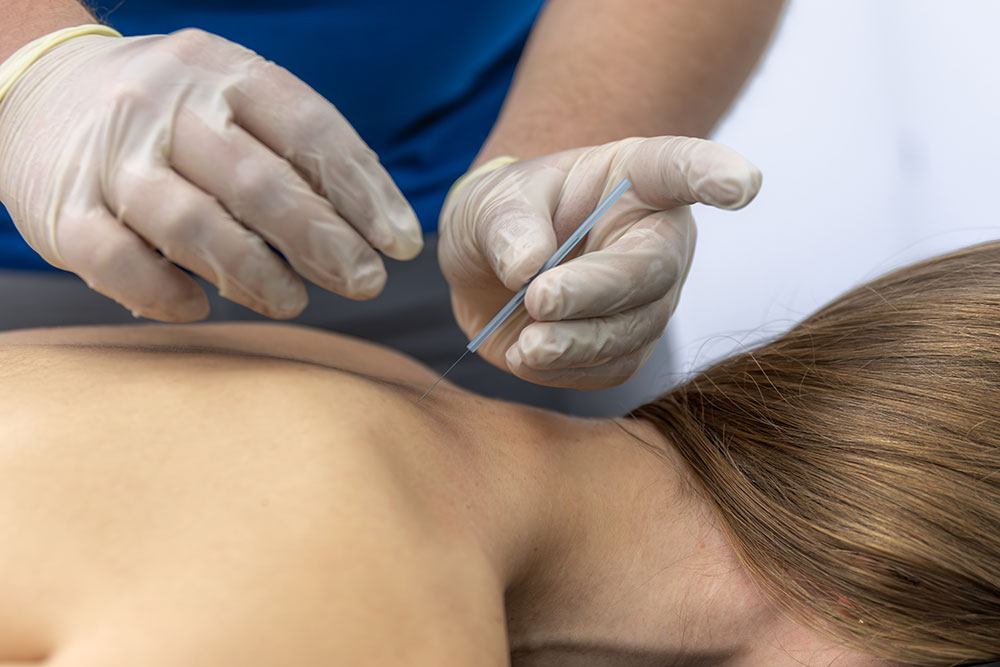
Evidence-based trigger point dry needling to release tight muscles, reduce pain, and restore movement — a powerful complement to manual therapy and rehabilitative exercise.
Schedule a Session
Dry needling uses thin, sterile filiform needles inserted directly into myofascial trigger points — hyperirritable nodules within taut muscle bands that cause local and referred pain, restrict range of motion, and inhibit muscle function.
Unlike acupuncture, which is rooted in traditional Chinese medicine, dry needling is based entirely on Western anatomy, neuroscience, and musculoskeletal medicine. The goal is mechanical and physiological: deactivate the trigger point, restore normal muscle length, and improve the tissue environment for healing.
When combined with manual therapy and therapeutic exercise, dry needling frequently produces faster, more durable results than either approach alone.
Trigger points in the cervical and thoracic musculature are among the most common causes of chronic neck pain and tension headaches.
Lumbar trigger points in the erector spinae, quadratus lumborum, and gluteal muscles are frequent contributors to persistent back pain.
Rotator cuff trigger points, bicipital tendinopathy, and scapular dyskinesis all respond well — restoring overhead mechanics and reducing impingement.
Hip flexor, piriformis, and gluteal trigger points are common in runners, cyclists, and anyone with prolonged sitting. Dry needling restores length and reduces referred pain.
Cervicogenic headaches originating from neck and suboccipital trigger points often respond dramatically — reducing both frequency and intensity.
Tennis elbow, plantar fasciitis, IT band syndrome, and calf strains all involve myofascial components that dry needling addresses directly.
Dr. Nelson palpates the target muscle to locate active trigger points, confirming the clinical picture matches your symptoms and history.
A sterile needle is inserted into the trigger point. You may feel a local twitch response — a brief muscle contraction that signals the point has been engaged. This is normal and therapeutic.
Mild muscle soreness for 12–24 hours is common. Many patients notice improved range of motion and reduced pain within 24 hours of treatment.
Needle insertion is typically not felt — the needles are extremely fine. The local twitch response, if it occurs, is a brief involuntary muscle contraction lasting 1–2 seconds. Most patients find it very tolerable and are often surprised by how minimal the discomfort is.
Many patients notice reduced pain and improved mobility within 24–48 hours of their first session. For chronic or complex conditions, a series of sessions produces the most consistent results. Dr. Nelson combines dry needling with manual therapy and exercise for the best outcomes.
They use the same needle but are distinct practices. Dry needling is rooted in Western anatomy and performed by licensed physical therapists — the goal is to deactivate trigger points and restore muscle function. Acupuncture is rooted in traditional Chinese medicine and delivered by licensed acupuncturists following a separate philosophy and training pathway.
Dry needling is very safe when performed by a trained clinician. Contraindications include needle phobia, blood-thinning medications (case-by-case), compromised immune system, local skin infection, and pregnancy in certain areas. Minor bruising at the needle site is possible. Serious adverse events are exceedingly rare. Your full health history will be reviewed before treatment.
Schedule a session with Dr. Nelson and experience how targeted dry needling can unlock mobility and relieve pain that has lingered for too long.